Costs & planning
What actually drives the cost of a paver patio
Two patios the same size can differ enormously in price. Here is what moves the number, and which savings cost you more later.
Read →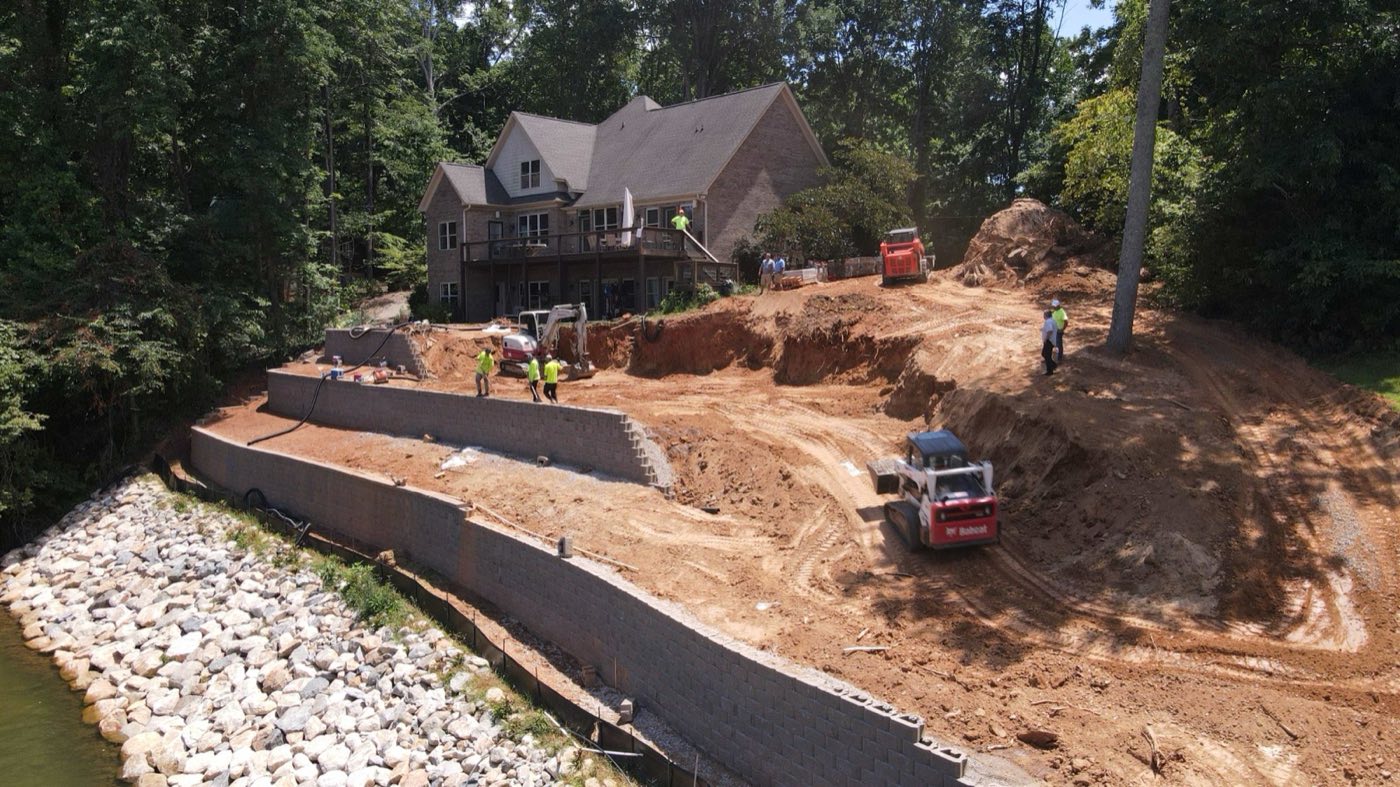
Retaining walls · 7 min read
Almost every failed wall we are called to has the same three causes. None of them is the block.
Introduction
We get called out to failing walls fairly regularly, and there is a pattern. The blocks are almost never the problem. What fails is what went in behind and beneath them — and by the time a wall is visibly leaning, the cause has usually been at work for years.
(01)
This is the big one. Soil holding water is dramatically heavier than dry soil, and that weight pushes horizontally against the back of the wall. It is called hydrostatic pressure, and it is what takes walls down.
A wall built properly has an escape route designed in: clean crushed stone behind the block rather than backfilled soil, a perforated pipe at the base, and an outlet where that water actually leaves. Fabric between the stone and the soil so the stone does not silt up over time.
A wall built without it is a dam. It will hold for a while. Then a wet winter arrives and it does not.
(02)
A wall is only as level as the trench it started in. That first course has to sit on compacted aggregate, buried below grade, and it has to be dead level. Every course above amplifies whatever the first course got wrong.
Walls that were started on soil, or on a base that was not compacted, settle unevenly. You see it as a dip along the top of the wall, or as courses that no longer line up.
(03)
A gravity wall holds by mass alone — its own weight against the soil. That works to a point, and past that point it does not.
Where the wall is taller, or where there is a slope above it, or a driveway, or anything else adding load, the wall needs to be tied back into the soil it is holding. That is what Geo-Grid does: layers of reinforcement laid back into the fill as the wall goes up, turning wall and soil into a single mass.
Skipping it does not cause an immediate failure. It causes a slow forward lean that becomes obvious years later. We cover the two types in more detail on our <a href="/retaining-walls">retaining wall page</a>.
(04)
You do not need to be a contractor to spot a wall in trouble. Walk it and look for these.
(05)
The honest answer depends on the cause, and this is where homeowners are most often sold the wrong thing.
If the wall is leaning because it has no drainage and no reinforcement, resetting the face does not fix anything. The cause is still behind it, and you will be looking at the same lean again. That is a rebuild.
If a wall is fundamentally sound and has settled in one localised area — a washout at one end, a failed outlet — a targeted repair can be genuinely worthwhile.
Our position when we look at one: we will tell you which of the two you have, even when the answer is the cheaper one.
(06) Questions
Related services
More from the blog
All articles →Costs & planning
Two patios the same size can differ enormously in price. Here is what moves the number, and which savings cost you more later.
Read →Materials
Both work here. But our clay and our freeze-thaw cycles push the answer one way more often than the other.
Read →Materials
Heat underfoot, freeze-thaw, shade and algae. Five surfaces, and what each is genuinely good and bad at here.
Read →Free on-site estimate
Tell us what you have in mind. We come out, walk the ground with you, and put a clear written estimate in your hands.
Request an estimate
Send the details and we will come out, walk the ground with you, and put a clear written estimate in your hands. No cost, no obligation.