Materials
Pavers or concrete? What Carolina clay says about it
Both work here. But our clay and our freeze-thaw cycles push the answer one way more often than the other.
Read →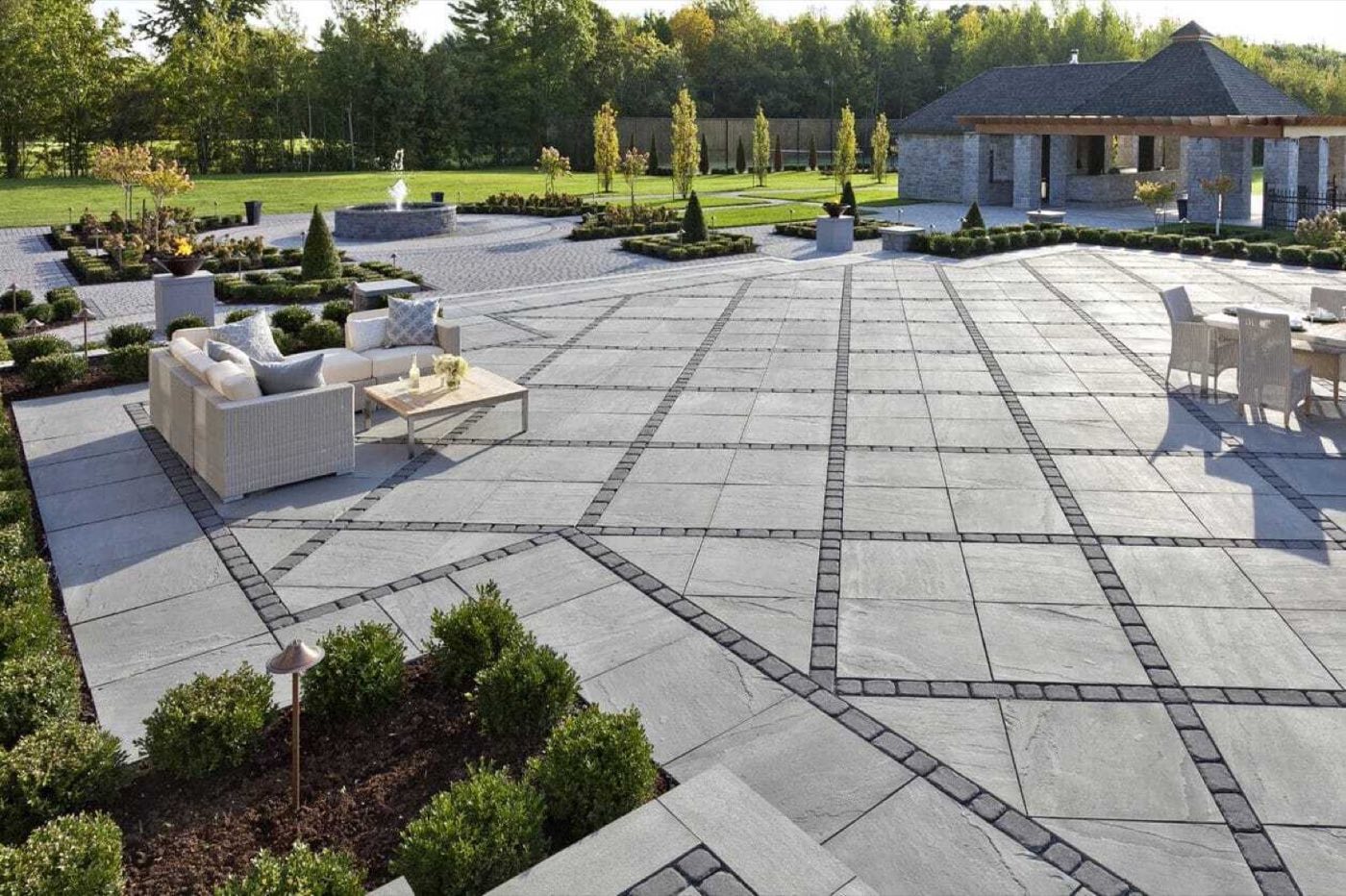
Costs & planning · 6 min read
Two patios the same size can differ enormously in price. Here is what moves the number, and which savings cost you more later.
Introduction
Nobody quotes a patio by the square foot alone, and any contractor who does is either guessing or leaving something out. Two patios of identical size on the same street can differ substantially in price, and the difference is almost never the pavers.
Here is what actually moves the number on a Lake Norman project, roughly in order of impact.
(01)
The base is the single biggest variable and the one you will never see again once the job is done. On Piedmont clay we are not laying pavers on dirt — we are excavating, bringing in crushed stone, and compacting it in lifts until it behaves like rock.
How deep that goes depends on what we find. Undisturbed ground with decent drainage needs less. Soft fill on a graded subdivision lot needs more, sometimes considerably more. On a driveway or anywhere a vehicle will run, it goes deeper again.
A contractor who skips this is cheaper on the day and much more expensive in three years, when the patio has settled into a birdbath and the only fix is to take it up and start over.
(02)
This is the cost driver homeowners are most often surprised by. If a machine can reach the back garden, base stone goes in quickly. If it cannot — because of a narrow side gate, a steep drop, mature trees or a neighbour's fence — the same tonnage moves by barrow, and that is labour.
On tight <a href="/cornelius-hardscapes">Cornelius lakefront lots</a> in particular, access can be the difference between a straightforward job and a slow one. We walk it before we quote for exactly this reason.
(03)
A rectangle is cheap to lay. Curves, circles, borders in a contrasting colour and any pattern that requires cutting are all slower, and they generate waste — you buy pavers you then cut into offcuts.
That is not an argument against curves. A curved patio can look far better than a rectangle. It is an argument for deciding early, because changing the shape after material is ordered is expensive.
(04)
Most patio budgets are set by the flat area and then blown by everything attached to it. Steps are structural. <a href="/retaining-walls">Seat walls and retaining walls</a> are structural. An <a href="/outdoor-kitchens">outdoor kitchen</a> needs footings, and usually gas, water and power. Lighting needs conduit run before the surface goes down.
None of these are expensive surprises if they are in the plan from day one. All of them are expensive surprises if they are added after the base is compacted.
(05)
If the patio sits where water already collects, drainage has to be part of the project. Grading, a catch basin, a run of pipe to somewhere sensible. On some sites this is a small line item and on others it is a significant one, but the alternative — a patio that ponds — is not really an alternative.
We cover this in more depth in our guide to <a href="/blog/fix-standing-water-carolina-yard">fixing standing water in a Carolina yard</a>.
(06)
There are honest savings and there are false ones.
Real savings: choosing a standard paver in a standard colour rather than a premium line; keeping the shape simple; phasing the project so the patio goes in this year and the kitchen next year; doing your own planting afterwards.
False savings: a thinner base, skipping drainage, no edge restraint, or sand joints instead of polymeric. Every one of those saves a little now and costs a lot later.
(07) Questions
Related services
More from the blog
All articles →Materials
Both work here. But our clay and our freeze-thaw cycles push the answer one way more often than the other.
Read →Retaining walls
Almost every failed wall we are called to has the same three causes. None of them is the block.
Read →Materials
Heat underfoot, freeze-thaw, shade and algae. Five surfaces, and what each is genuinely good and bad at here.
Read →Free on-site estimate
Tell us what you have in mind. We come out, walk the ground with you, and put a clear written estimate in your hands.
Request an estimate
Send the details and we will come out, walk the ground with you, and put a clear written estimate in your hands. No cost, no obligation.